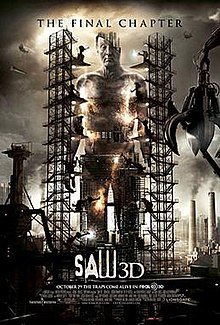
When looking
at shot composition and editing in films, these two aspects set apart the
professionals from the amateurs. Shot composition cannot be simply pointing a
camera and filming what appears in the field of view, but instead it “refers to
the art and practice of arranging the visual elements on the screen so that
they communicate your intended message clearly” (Hason, 1999). While editing
has various aspects that directors and filmmakers alike can choose to create
their story on screen. Common themes and elements in shot composition and
editing are portrayed in the seven films of the “Saw” franchise.
Throughout
the “Saw” franchise shot composition plays a vital role in portraying the gory,
gruesome rooms and deaths. In all of the films, director James Wan frames each
room in focus as a wide shot showing the audience where the game is being
played. From there are sharp action cuts to show the people who about to die in
the game. From the first film to the seventh Wan use a variety of rack focusing
to portray the various traps that these pawns will be trapped into. Another constant
theme throughout the film is spinning frames to show a person in trouble. An
example is in “Saw 3D” where the opening scene twist from the floor to the top
to show a girl harassed in and about the cut in half by a large blade. The shot
composition themes all tie in together throughout all seven films.
In
films one through six, they all end with a door closing on a victim from game
and have an overall cliff hanger feel that allows for the series to continue.
Typically, the final scene is the Jigsaw character revealing themselves to the
victim by either shutting a door, locking them in the game, or escaping through
a trap. This leaves the audience with the feel that there will be another film
and there is more to the film then meets the eye.
One
type of editing utilized in all of the “Saw” films is elliptical editing, in
which edits action to shorten time on screen than it plays out in the story.
Typically in all seven movies the main character has a particular set amount of
time to finish the game or accomplish their goal. Most of the time the horrific
character Jigsaw gives the main pawn of the game or a room of people a set allowed
time. In the first film, Dr. Lawrence
has six hours to kill Adam in the bathroom before Jigsaw kills his daughter and
wife. In “Saw II” the group of people held captive in the house has only a
couple of hours to find antidotes before the gas in the home
kills all of them. Finally, throughout all the films there are various traps
that people must escape out of unless they will be killed. Typically, these
people only have minutes to escape from the traps. But in all of these examples
the films do not last as long as say the six hours that Dr. Lawrence has to
kill Adam. Even though in the films, the games end after the time is up, but it
does not take the actual time that Jigsaw gives them.
Throughout
all seven saw films, there are flashbacks that present one or two stories out
of order. In all of the films, Jigsaw uses a dead pig head as a mask and chloroforms
people when they least expect it. But before this all happens, the audience
does not know how the pawn in the deadly game gets to that location. It is not
until the film shows flashbacks of the people attempting to remember how they
got there and then actually showing the audience. In “Saw V” Detective Hoffman is
the new Jigsaw character and he runs the games, captures the people, and is
still a part of the detective team. Peter Strahm, whom is also a detective, is
on the hunt for the Jigsaw killer, but he does not know who it is. In the end
of the film, Detective Strahm is a pawn in the game and through flashbacks Detective
Hoffman reveals himself as the Jigsaw killer. It was not until the end of the
film and through the use of flashbacks does Peter Strahm realize who the Jigsaw
killer actually is.
Hanson, L.
(1999, May 23). Shot Composition. Videography Basics. Retrieved April
23, 2012, from www.personal.kent.edu/~lhanson/shotcomposition.htm
Greutert, K.
(Director). (2010). Saw 3D [Motion picture]. North America: Lions Gate
Entertainment.

No comments:
Post a Comment