Tuesday, April 24, 2012

The Shot and Editing


            When looking at shot composition and editing in films, these two aspects set apart the professionals from the amateurs. Shot composition cannot be simply pointing a camera and filming what appears in the field of view, but instead it “refers to the art and practice of arranging the visual elements on the screen so that they communicate your intended message clearly” (Hason, 1999). While editing has various aspects that directors and filmmakers alike can choose to create their story on screen. Common themes and elements in shot composition and editing are portrayed in the seven films of the “Saw” franchise.

            Throughout the “Saw” franchise shot composition plays a vital role in portraying the gory, gruesome rooms and deaths. In all of the films, director James Wan frames each room in focus as a wide shot showing the audience where the game is being played. From there are sharp action cuts to show the people who about to die in the game. From the first film to the seventh Wan use a variety of rack focusing to portray the various traps that these pawns will be trapped into. Another constant theme throughout the film is spinning frames to show a person in trouble. An example is in “Saw 3D” where the opening scene twist from the floor to the top to show a girl harassed in and about the cut in half by a large blade. The shot composition themes all tie in together throughout all seven films.

            In films one through six, they all end with a door closing on a victim from game and have an overall cliff hanger feel that allows for the series to continue. Typically, the final scene is the Jigsaw character revealing themselves to the victim by either shutting a door, locking them in the game, or escaping through a trap. This leaves the audience with the feel that there will be another film and there is more to the film then meets the eye.

            One type of editing utilized in all of the “Saw” films is elliptical editing, in which edits action to shorten time on screen than it plays out in the story. Typically in all seven movies the main character has a particular set amount of time to finish the game or accomplish their goal. Most of the time the horrific character Jigsaw gives the main pawn of the game or a room of people a set allowed time.  In the first film, Dr. Lawrence has six hours to kill Adam in the bathroom before Jigsaw kills his daughter and wife. In “Saw II” the group of people held captive in the house has only a couple of hours to find antidotes before the gas in the home kills all of them. Finally, throughout all the films there are various traps that people must escape out of unless they will be killed. Typically, these people only have minutes to escape from the traps. But in all of these examples the films do not last as long as say the six hours that Dr. Lawrence has to kill Adam. Even though in the films, the games end after the time is up, but it does not take the actual time that Jigsaw gives them.

            Throughout all seven saw films, there are flashbacks that present one or two stories out of order. In all of the films, Jigsaw uses a dead pig head as a mask and chloroforms people when they least expect it. But before this all happens, the audience does not know how the pawn in the deadly game gets to that location. It is not until the film shows flashbacks of the people attempting to remember how they got there and then actually showing the audience. In “Saw V” Detective Hoffman is the new Jigsaw character and he runs the games, captures the people, and is still a part of the detective team. Peter Strahm, whom is also a detective, is on the hunt for the Jigsaw killer, but he does not know who it is. In the end of the film, Detective Strahm is a pawn in the game and through flashbacks Detective Hoffman reveals himself as the Jigsaw killer. It was not until the end of the film and through the use of flashbacks does Peter Strahm realize who the Jigsaw killer actually is.

Hanson, L. (1999, May 23). Shot Composition. Videography Basics. Retrieved April 23, 2012, from www.personal.kent.edu/~lhanson/shotcomposition.htm

Greutert, K. (Director). (2010). Saw 3D [Motion picture]. North America: Lions Gate Entertainment.


Torture Porn

 The sub-genre, torture porn, has moved generated a new type of horror film and has even indulged into social and political context. According to Evangelos Tzialla, “torture porn refers to a loose association of feature fiction films featuring scenes of extreme violence and torture.” Common characteristics of torture porn are portrayed through graphic depictions of extreme violence, nudity, torture, mutilation and sadism (Edelstein, 2006). Through the use of surveillance, the “Saw” series provides clear examples of torture porn throughout all seven movies. The success of “Saw” could be in part with our cultures obsession with surveillance. This is all done by the loss of privacy brought upon institutional, corporate, and government surveillances. Examples in our culture include schools monitoring Internet use, work places monitoring social networking, and government watching for traffic violations. Tziallas also attributes, the rise of surveillance in torture porn through “our appropriation of surveillance as a form of entertainment” (Tziallas, 2009). In today’s culture, people are fascinated with watching others.
        In the movies Hostel and Hostel: Part II, director Eli Roth wrote these films through the lens of the America’s recent September 11th attacks and the war on terror. Director Eli Roth commented about his films, “Right now we're at war… I have this feeling that civilization could collapse, and that if you go overseas, you could get killed…This film is also about the dark side of human nature” (Riegler, 2010). Not only do these films feature extreme close-up violence of torture and gore, but these two graphic films reflect America’s culture of fear. In Hostelthe film provides examples of how dangerous the world is and how civilization could crumble. The basis of the film revolves around young Americans traveling around Europe looking for a good time. They are promised alcohol, sex, and free living to stay at a Bratislava youth hostel, but eventually they are abducted and are the subjects to sadistic treatments. The people behind the scenes are rich American business men who pay a large fee to murder them with various torture tools. Hostel and Hostel: Part II provide clear examples of the social culture of America coming off the attacks on September 11th, the political aspect of fighting a war on terror overseas, and the economy of large business ruling and controlling what they want.


Edelstein, D. (2006, January 28). Torture Porn: The Sadistic Movie Trend  -- New York Magazine. New York Magazine -- NYC Guide to Restaurants, Fashion, Nightlife, Shopping, Politics, Movies. Retrieved February 28, 2012, from http://nymag.com/movies/features/15622/

Riegler, T. (2010). We're All Dirty Harry Now: Violent Movies for Violent Times. At The Interface / Probing The Boundaries, 7017-41.

Tziallas, E. (n.d.). Torture porn and surveillance culture by Evangelos Tziallas. JCsplash. Retrieved February 28, 2012, from http://www.ejumpcut.org/currentissue/evangelosTorturePorn/index.html

Mise-en-scene


            The director of a film controls what audiences see on screen, but they cannot control the way certain people interpret a film. Before movies dominated entertainment, there were plays that took months to years to write and direct. After seeing a film, one may not remember particular cuts or effects in various shots, but one may remember an outrageous costume or eerie setting. The cinema term mise-en-scene can best be applied to what audience members remember or take away from a particular film.  Mise-en-scene is the arrangement of everything that appears in frame for the camera to film. This includes all actors, lighting, settings, props, makeup, and costumes (Moura, 2011). Originally the term was used by the French meaning “placing on stage” and applied to the directing plays. Even though there many professionals that all take part in creating a film, the director is the one that oversees the entire mise-en-scène and all of its elements (Moura, 2011).

            Director’s use various elements achieve mise-en-scene and control what audiences see on screen. The first aspect that comes into mind when talking about mise-en-scene is realism. Many films are judged based whether or not the film appears too real. Even though this is standard value, it is also a standard that is problematic. When people view films across different cultures and at different times what may be “real” today may not be “real” in the future. A large portion of mise-en-scene is the setting aspect to a film. The setting of a particular film or scene could incorporate particular colors throughout, props, staged set, exterior shots, and the film is typically evoked by the setting. Mise-en-scene incorporates various forms and styles. The overall system of that viewers perceive from the different elements in the whole film, typically the plot, is considered the film form. Mise-en-scene has a particular style to it as it has a unified, developed, and significant use of particular technical choices and provides a formal system of their own. Finally, the costume and makeup play a major role as it emphasizes or deemphasize human figures against the setting.

            In the film, “Hostel” written, produced, and directed by EIi Roth the aspects and forms of mise-en-scene take place in a vital scene of the movie. The film revolves around three American college students traveling Europe simply looking for a good time. After meeting a man at a party, the stranger tells them of a hostel near Bratislava where they can continue their party with good looking women and stay for free. But the party came crashing down when after a night of party they were slipped drugs and woke up cuffed in a dreary dungeon type room. Cutting the end of the film, as the main character Paxton, escapes by shooting the guards, hiding out, and drives away from the scene. But before completely escaping, Paxton must hide and that scene shows most aspects of mise-en-scene.

The scene begins with Paxton hiding in cart that has mangled bodies and bloody body parts. To convey realism director Eli Roth uses “sensation directly to the audience, to make them imagine the queasy feeling of being smothered by bloody corpse parts, begins as an exercise in identification but ends in the realm of attractions” (Lowenstein, 2011). The expression from Paxton gagging and being terrified portrays the realism of the bodies. In the scene, the setting has very low lighting “which is often seen in horror movies and thrillers, comprising of a lighting pattern that has both bright and dark areas in the frame” (Moura, 2011). When showing the setting to the audience, Roth grabs them in by showing a sawed off hand dropping from a desk, its presentation to the audience emphasises the sheer visual curiosity and visceral sensation aroused by the macabre image of a severed hand in all its carnality” (Lowenstein, 2011). All throughout the film and in this particular scene, the film form is quite simple to the viewers as the plot is the Elite Hunting Club pays people to kidnap young teens and then they pay a price to torture them. Finally, in this particular scene, the costume and makeup adds a chilling element to the scene. Roth incorporated many point of view shots which encompass the audience being in Paxton’s place, which is lying bloody with heavy dead bodies on him.


Lowenstein, A. (2011). Spectacle horror and Hostel: why 'torture porn' does not exist.     Critical Quarterly, 53(1), 42-60. doi:10.1111/j.1467-8705.2011.01976.x


Moura, G. (2011, February 1). mise-en-scene. Elements of Cinema | A Student's Guide to the Fundamentals of Filmmaking. Retrieved April 24, 2012, from http://www.elementsofcinema.com/directing/mise-en-scene.html


Form and Meaning

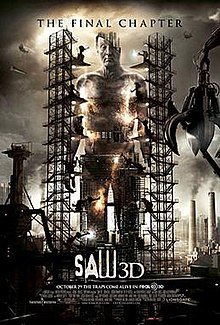
File:Saw poster.JPG

         
        When looking at a film as a whole, it can best be related to system, in which a group of elements affects one another. An example used outside of film could be relating to a football team organization. The organization starts at the top with the owner, works down to his appointed vice presidents, down to the general manger, head coach, and then finally the players on the field. All of these elements in the organization must work together to perform as a working system, if one of them fails at their position the organization will falter and eventually fail. Relating film to a system, the form of a film must be established. According to Film Art: An Introduction the form of the movie is “the overall system of relationships among the parts of a film” (Bordwell & Thompson, 2010). In the “Saw” film series, all films have a basic system of torturing people in a horrific bloody way. The games played in these films all exhibit “Excruciating forms of torture and free-form bloodletting seem to be their chief draw” (Sharrett, 2009). From the first film all the way to the seventh and final film, the “Saw” series forms a group of element of a couple or a group of people attempting to escape one of Jigsaw’s games. The people in these games all have a back stories as to why they are in that situation. Typically, these people do not appreciate the life they live or have caused pain to others. Jigsaw attempts to cleanse these people and form them by torturing them back to living life while they can.  From film to film the local police and detectives are always on the manhunt for the Jigsaw killer, who the original actually dies in the fourth film, but his reign continues but his accomplices.  The audiences’ of these films actively relate the elements of the people, the games, Jigsaw, and the back stories in the film. To expand on that, in order to completely understand all seven films viewers must relate elements of all the films together to understand the complete system in the end.

         The meaning to a movie is important to audienece’s experience of what is taking place on screen. When an audience member views a film, typically thoughts of what is the larger scale of the movie takes place. The audience member does not simply take what is seen and not think about a deeper meaning. Their minds are constantly grasping what is taking place on screen and making sense of that. When looking at the implicit meaning of the film it is, the signifincance left for the viewer to discover upon analysis or reflection. Basically it is when the viewer interprets different aspects of the movie and attempts to understand why that happened in the film. According to Christopher Sharrett, he believes that “Saw” does reach out to today’s audience for implicit meaning. “The numerous gory tableaux of Saw tend to make one see them as further indicators merely of a braindead culture rather than inextricably linked to the political reaction and cynicism that pervades the cycle, making Saw a perfect emblem of the recent era’s rightist ideology” (Sharrett, 2009). Sharrett makes the point that in today’s world people go to the movies for sheer entertainment. That entertainment in “Saw” is the obscene amount of killings, bloodshed, interesting games, and the various deaths themselves. There is nothing more than just pure blood and death behind the film according to Sharret. Another way of looking at the meaning of a film is the symptomatic meaning which is, the significance that a film divulges, often against its will, by virtue of it’s historical and social context. To fully understand this, the social ideology must be understood. That is the meaning that springs from culturally specific beliefs about the world. In the article, “Your Sick This is not Art” Rjurik Davidson states, “Such fears, which are often political, economic, and psychological rather than supernatural, give the best work of horror a pleasing allegorical feel - and it's the sort of allegory that most filmmakers seem at home with.” In many horrors films, including the torture porn category, many references to people’s fear of their culture come into play. An example in “Hostel” is the sheer fear of traveling abroad and out of the comfort of your know culture. Everything is new to the person and in the movie it ends up that Americans are the one’s at fault. The meaning of this film can relate to sheer fear one’s culture and abroad.

Sharrett, C. (2009). The Problem of Saw: "Torture Porn" and the Conservatism of Contemporary Horror Films. Cineaste, 35(1), 32-37.

Davidson, R. (2011). 'YOU ARE SICK! THIS IS NOT ART!'. Overland, (205), 41-46

Monday, April 23, 2012

The Beginnings of Horror


“Horror films are unsettling films designed to frighten and panic, cause dread and alarm, and to invoke our hidden worst fears, often in a terrifying, shocking finale, while captivating and entertaining us at the same time in a cathartic experience” (Dirks, 2012). The genre dates back over one hundred years ago where filmmakers used their imagination and fear to make short films in a gothic style. Over the span of hundred years, the horror genre has been cast into various subcategories. These subcategories develop and change over time due to technological advancements, culture mindsets, political shifts, and simply a twist on the horror norm. When looking at the horror genre a few sub-categories have made huge strides in casting a different light upon the genre. The sub-categories that have changed the way viewers look at horror films are slasher, zombie, and torture porn. All three bring a different element to the horror genre’s history, form, content, social, and political significance.

            All horror films begin with the basis of human fears and what type of emotions occur when people are face-to-face with their fear. From the earliest cultures, religions, myths, and folklores, and up to present time common elements appear to fear humans. In nature leeches and vampire bats have always frightened people of all cultures. Religions across the world have always had a fear of hell which involves demons and the supernatural. Blood, fire, sex, and corpses symbolize the human fear in religion. In various cultures, tribes, and cults the practice of cannibalism drives the human fear of being killed in eaten. The earliest film directors took human fear and incorporated their own imagination to write, producer, and stage many of the earliest horror films.

            In what is considered to be the first horror movie made, titled Le Manoir Du Diable  (The Devil's Castle/The Haunted Castle) by  French filmmaker Georges Melies, is only two minutes in length (Dirks, 2011).  The film contained elements of a flying bat, a gothic castle, demons, skeletons, the supernatural, and a crucifix to portray evil. During the silent moviemaking era the earliest horror films dealt mainly with vampires, monsters, and the twisted human. Moving throughout an early timeline the monster films filled up the horror genre of fears of mummies, Dracula, Frankstien, and Werewolves came to haunt viewer’s minds. During the 1930’s and 40’s zombie films began their cycle into the movies, which would soon take off in the 1960’s and 70’s. In the 1950’s movies such as The Blob and The Fly brought on a new subgenre called body horror, which dealt with human genetic mutation. Alfred Hitchcock, a brilliant suspense/thriller director, brought new light in horror with movies such as Psycho, The Lodger, and The Birds  In what can called the turning point of the horror genres during the 1970 came about the sub-categories of the slasher/stalker film, body horror films, the start of sequels, and zombie sub-categories. Finally during the 1990’s horror films began recycling the sub-categories with new and improved technology and the 2000’s saw the rise of torture porn.

Dirks, T. (2011, July 1). Horror Films. Greatest Films - The Best Movies in Cinematic History. Retrieved March 21, 2012, from http://www.filmsite.org/horrorfilms4.html

Bordwell, D., & Thompson, K. (2010). Film Art: An Introduction (9th ed.). Boston: McGraw Hill.


Genre Analysis


                  When looking at the sub-categories of slasher and zombie, both have very distinguishable icons, themes, and motifs. The slasher film revolves around a psycho killer that has typically had a rough up-bringing that has led him to a life of killing. In the type of film, the killer stalks and kills various amounts of victims in a violent manner, usually doing so with an ordinary weapon or by any means possible. Taking a look at slasher films such as Halloween, Friday the 13th, and A Nightmare on Elm Street all include setting where violent killings should not occur. “The slasher subgenre has made superhuman killer invade everyday settings such as summer camps and suburban neighborhoods” (Bordwell & Thompson, 2010). In slasher films visual cues of masks and altered faces make up the killer. In both Halloween and Friday the 13th the killer wears a typical mask that anyone can have such as a hockey mask. But in A Nightmare on Elm Street, Freddy Krueger has been severely burned and sacred. The iconographies of these films leave viewers reflecting whether or not this could happen in their small town or can people really kill like that. The plot of many slasher films deals with the killers attack on normal life in the small town or neighborhood. In the article, “Children of the Light” by Bruce F. Kawin  “In a horror story a lot of people get killed, but no one really cares about them; the audience’s attention skips from victim to victim until it finds the survivor, the one with whom it is thrilling but safe to identify.” In the previous mentioned slasher films, all three deal with the theme of a sequence of events that lead to the killings of specific people in order. The audience has a restricted narration as they follow the psycho killer until the very last kill. From these films, directors never intend for people to take use their work in their own lives. An example of symptomatic meaning from slasher films would be for a viewer be so indulged that they use the actions on screen in their own lives.

            “The horror genre is most recognizable by the emotional effect it tries to arouse. The horror film aims to shock, disgust, repel-in short, to horrify” (Bordwell & Thompson, 2010). In zombie films, which deal with creatures that are portrayed typically as mindless people from the dead. In this sub-category, zombies typically arise from the dead or there is a zombie apocalypse. Throughout the film, no character is ever hundred percent sure how the zombies have risen, but this allows for viewers to be guided along finding out the source with character. Typically, in zombie apocalypse films humans across the country or world have gone ill by some unknown source, have died, and have risen from the dead as flesh eating zombies. The first of its kind is from George A. Romero’s Night of the Living Dead, in which “it takes a hard look at the world that is in danger of being taken over by flesh-eating zombie, and few of the living measure up; most are selfish, violent, stupid” (Kawin & Mast, 2006). That film has been the basis of zombie films since. The iconography of zombie films typically deal with heavy makeup, battered clothing, and slow mannered people. The significance of this is to leave the audience pondering what does happen in the afterlife? After the film ends, many viewers question the fact of a zombie apocalypse even occurring or one may take away that being the cycle of life. Typically in zombie films, the theme is to stay alive and find a cure to the epidemic. But most of the time these themes mean more than just a film. According to Thomas Riegler, “1970s violent movie genres fed on political and social turmoil that began in the late 1960s: The Vietnam War, a string of high profile political assassinations, racism, and urban riots.” In Night of the Living Dead, that example is clear when the strongest, smartest, most resourceful character is played by an African American. Romero used the first black man in a lead role to resemble the social era of the 1960’s (Kawin & Mast, 2006). The character survives one night but is shot and burned by a southern redneck that resembled news coverage of the social racism going on during the civil rights movement. This type of zombie filmed over way beyond the explicit and implicit meaning of the film.
              Over the span of one hundred years, the horror genre has developed into various sub-categories that can strike fear into the hearts of every viewer. What started off as low budget films, the horror genre have taken new heights using today’s technology to implement fear among its viewers. In the sub-categories of horror include, slasher, zombie, and torture porn. All three bring their own element of fear whether it being a psycho killer in the neighborhood, the life cycle of death coming back alive, or the intensity of cruel torture. But what cannot be pushed aside is the fact that horror films not only entertain us, but they do reflect contemporary horrors of American culture whether it is socially, politically, or economically.


Grant, B. K., & Kawin, B. (2003). Children of the Light . Film Genre Reader III (pp. 324-329). Austin, Texas: University of Texas Press.
Mast, G., & Kawin, B. F. (2006). A short history of the movies (9th ed.). New York: Pearson Education Inc. .