Tuesday, February 28, 2012

Scene Analysis

(The Link to the English Version - http://www.youtube.com/watch?v=jXMMgz1PJYM)
            The opening scene of “Saw” hits home to viewers as the introduction fades to black and see a light color shining through a dark mucky scene. Quickly a face an awakened face emerges and the man in the water appears to be in total shock. Trying to gain back his sense, the man rolls out of the bath tub and onto the dark room’s floor. Soon after, what opened the scene is quickly removed as the key gets flushed down into the drain when the man awoke. From the very beginning, viewers are introduced to a dreary, dark, and mysterious bathroom. Just like in most horror movies there are plot twist that takes viewers on a roller coaster ride throughout the movie. “Saw” incorporates an element of question and doubt by flushing the mysterious key within the first minute of the movie. This leads viewers to believe whether or not that key was vital for survival, release, or completely useless. Once the shaken man regains his senses and mind, he finds a light switch. As soon as that light switch was turned on, the new murder room takes place, a character is born, the plot thickens, and the movie essentially ends.
As the first scene develops so does the plot, in the first “Saw” film the plot revolves around two characters that mysteriously end up in an old, rustic looking bathroom. The first character shown is Adam, a free lance photographer, who awakens in a cold dreary bathtub with water flowing to his mouth. Awaked by the sheer coldness of the water and the bathroom Adam quickly realizes that he is a long way from home and that he is main stage of a murder plot. Opposite of Adam is Dr. Lawrence Gordon, who is seen to be in a complete sweat or has been in water just like Adam. Just like Adam, Dr. Lawrence quickly realizes that he is a pawn in a room. As both characters attempt to simply walk out of the bathroom, they realize that they are shackled to pipes by one foot. Director James Wan and Leigh Whannell only shackled one foot to allow for movement in the room, as the two of them are a pair of pawns in a game.
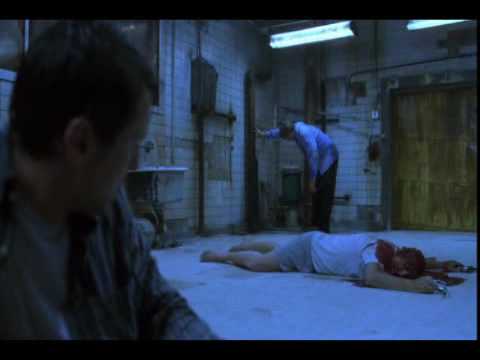
The scene develops as Adam and Dr. Lawrence see what appears to be a dead body in the middle of the room, holding a tape recorder and a shiny silver revolver. The viewers are first introduced to the bloody body, by a close up that quickly twisting towards the ceiling to a wide shot showing the body. The video recorder and revolver are quickly revealed as back-to-back close-ups are shown. Within the first minute, two clear character differences appear. Dr. Lawrence is shown in a total panic attempting to push walls and scratch them for a sign. Adam searches his person and finds a small tape, which says “Play Me” written on the top of it. Once Adam retrieves the tape player, the tape tells him “You might be in the room that you die in. Up until now you've simply sat in the shadows, watching others live out their lives. But what do voyeurs see when they look in the mirror? Now, I see you as a strange mix of someone angry, yet apathetic, but mostly just pathetic. So are you going to watch yourself die today, Adam, or do something about it” (Saw I the Bathroom Trap). Soon after, Dr. Lawrence finds a similar tape and throws it over to Adam to be played. His tape reveals the plot of the movie, “Your aim in this game is to kill Adam. You have until 6 on the clock to do it. If you do not kill Adam by 6, then Allison and Diana will die, Dr. Gordon, and I'll leave you in this room to rot. Let the game begin. Follow your heart” (Saw I the Bathroom Trap).
With the movie and plot setup within the first handful of minutes, the audience is drawn in from the very beginning. The mystery of the room, the two characters held in captivity, and faced paced editing, leads viewers get emotionally attached to the film. The opening scene sets up the entire movie, as the main setting is the bathroom, the storyline revolves around how these two random people are connected, and who is doing this to them. The opening scene in “Saw” is very powerful as it indulges all viewers to a movie that they most likely have never seen before.
Mast, G., & Kawin, B. F. (2006). A short history of the movies (9th ed.). New York: Pearson Education Inc. .

Wan, J. (Director). (2004). Saw [Motion picture]. North America: Lions Gate Entertainment.

Surveillance in "Saw"

            Just like the phrase “Big Brother is Watching You” surveillance has been developed to be a common element in visual production.  Surveillance in television and cinematography has become a socially acceptable and is the basis for most productions. When describing surveillance in production and script writing, Thomas Levin states, ““It is this ambiguity—between surveillance as narrative subject, i.e. as thematic concern, and surveillance as the very condition or structure of narration itself—that will become increasingly characteristic of the cinema of the 1990s” (Tziallas, 2009). Levin best describes the way how many horror films has transformed the genre in both narration and production elements. Surveillance in horror movies has become mainstream in the sub genre torture porn. This trend in horror movies could be from cultural factors as gazing is biological.
            Over time horror movies have developed and created a sub genre called torture porn. According to Evangelos Tzialla, “torture porn refers to a loose association of feature fiction films featuring scenes of extreme violence and torture.”  Common characteristics of torture porn are portrayed through graphic depictions of extreme violence, nudity, torture, mutilation and sadism (Edelstein, 2006). Through the use of surveillance, the “Saw” series provides clear examples of torture porn throughout all seven movies. The success of “Saw” could be in part with our cultures obsession with surveillance. This is all done by the loss of privacy brought upon institutional, corporate, and government surveillances. Examples in our culture include schools monitoring Internet use, work places monitoring social networking, and government watching for traffic violations.  Tziallas also attributes, the rise of surveillance in torture porn through “our appropriation of surveillance as a form of entertainment” (Tziallas, 2009). In today’s culture, people are fascinated with watching others. Clear examples are evident in reality television show such as “Big Brother”" and movies such as “Disturbia.”   
            Taking a look at how surveillance is used in the movies “Saw”, “Saw II” , “Saw III” , “Saw IV”, and “Saw V” they display an array of technologies such as cameras, computer monitors, VCRs, televisions, and visual human gaze. In “Saw” we see two people, Dr. Lawerence Gordon and Adam Faulkner, detained in a room consisting of a bathtub and pipes coming from the wall. In “Saw II” detectives discovers Jigsaws room of surveillance monitors in an attempt to find the source. In “Saw II” we see self surveillance as a woman watches herself on a monitor being watched. Through this surveillance viewers can use imagery and fear which leads them throughout the story line. The “Saw” series uses viewer’s fear of being kidnapped for reasons beyond their knowledge and detained, confined, and tortured.
Edelstein, D. (2006, January 28). Torture Porn: The Sadistic Movie Trend  -- New York Magazine. New York Magazine -- NYC Guide to Restaurants, Fashion, Nightlife, Shopping, Politics, Movies. Retrieved February 28, 2012, from http://nymag.com/movies/features/15622/
Tziallas, E. (2009). Torture porn and surveillance culture by Evangelos Tziallas. JCsplash. Retrieved February 28, 2012, from http://www.ejumpcut.org/currentissue/evangelosTorturePorn/index.html

Monday, February 27, 2012

The Beginning of New Horror

            A franchise which all began back in 2003 as a short film directed by James Wan and screenwriter Leigh Whannell, has created their own niche in American horror. The two young Australian’s have taken over the American horror cinema photography with their “Saw” franchise. The foreign born directors, producers, writers, and actors have combined to make a total of seven movies under the franchise name “Saw” with the help of Lions Gate Entertainment and produced by Twisted Pictures. Throughout the span of seven years, the series has grossed over 873 million dollars at the box office worldwide. According to the Guinness Book of World Records, Wan and Whannell has created the “Most Successful Horror Movie Series” (Serjeant, 2010). This horror series ranks among the best with notables such as “Nightmare on Elm Street,” “Halloween,” “Friday the 13th,” and “Child’s Play.”
            Born in Malaysia, but raised in Perth, Western Australia at a young age, James Wan is known for creating the American horror movie “Saw.” During his time at Royal Melbourne Institute of Technology, Wan developed a passion of film making and completed a bachelor ’s degree in the field of arts. Wan began his filmmaking career with the help of fellow classmate Shannon Young. The two of them co-directed and filmed a low budget action-horror film titled“Stygian” (Young, 2005). The underground film became an award winner and was shown at local and international film festivals. With a film under his belt, Wan would soon meet Leigh Whannell and the two of them would go on to create one of the best horror movie franchises of all-time. Before landing in Los Angles, the “Mecca” of film making, Wan directed a short nine minute subject horror movie, which was used to pitch their full-length movie “Saw.” An idea which all began as dreams and fears, Wan has developed to become one of the most successful horror directors ever to live.
            Hailing from Melbourne, Australia, Leigh Whannell, developed a passion of getting attention from his peers. That passion would blossom into filming, writing, and acting at the Royal Melbourne Institute of Technology, a impressive Media Arts         school. In only two year at school, Whannell he landed a camera man position on a show called “Recovery.” The show was filmed completely live by teenager and was ground breaking for alternative counter-culture Australians. Whannell blossomed as a host on that show and soon after college he found himself as a host or presenter on many Australian television shows. After a couple of small acting gigs, Whannell reached out to James Wan about creating a film on their own budget. Soon after “Saw” was born. It took nine months for Whannell to write the “screenplay for what he thought would be a self-financed, "Blair Witch"-style feature, with him starring and James directing” (Tuck, 2009).


Serjeant, J. (2010, July 22).  CORRECTED-Saw movie franchise to get Guinness world record| Reuters. Business & Financial News, Breaking US & International News | Reuters.com. Retrieved February 28, 2012, from http://www.reuters.com/article/2010/07/23/film-saw-idUSN2215375420100723
Tuck, C. (n.d.). Leigh Whannell - Biography. The Internet Movie Database (IMDb). Retrieved February 28, 2012, from http://www.imdb.com/name/nm1191481/bio
Young, S. (n.d.). Shannon Young. Innersense Productions / Bill Mousoulis. Retrieved February 28, 2012, from http://www.innersense.com.au/mif/young.html